AI automation for the four loops that still run through you
Enquiries, quotes and cash, the numbers only you can answer, and the records you're required to keep. Each starts with a fixed price and ends with a system your business owns.
Run covers systems we built. New features and new loops are scoped as a separate project.
Prices exclude VAT, third-party licences, hosting, paid data, travel and work beyond the signed scope. A signed statement of work confirms the boundary. If your job doesn't fit a package, we say why and scope it separately.
Not included
Native mobile apps and app-store publishing
Large or unverified data migrations
Integrations without a usable API
ERP replacement, complex payment systems and regulated product certification
Process
From one loop to a system you own
The same six control points in every project. The scope changes; the discipline doesn't.
01
Map the loop
We trace who does what, in which system, and where it waits for you, so the team can correct us before anything is built.
02
Draw the boundaries
Each step gets an owner: a rule, an AI task with limits, or a person who approves.
03
Design for failure
Duplicates, delays, outages and uncertain AI output each get a defined path and a way to resume.
04
Ship a narrow first release
One path that matters, with integrations, rules and interface built together.
05
Test real scenarios
Normal cases, missing data, slow systems and low-confidence AI results become acceptance tests.
06
Release and hand over
Staged rollout, alerts with named owners, documentation and access, plus the criteria for expanding.
AutomateFlow is an AI automation agency for owner-managed UK firms that builds systems around four loops: enquiries to bookings, quotes to cash, the questions only the owner can answer, and compliance records. Each engagement starts with a fixed price (Audit £3,500, Pilot £15,000, Build £35,000, Run £2,000 a month, excl. VAT) and ends with a system the business owns.
A loop is a piece of work that still waits for the owner. Each one has a check you can run yourself before and after we build, so you don't have to take our word for the result.
Swipe or scroll to compare the columns.
Loop
What we build
The check you can run
Page
Enquiries to bookings
AI agents on WhatsApp, web chat and email that reply, collect details and book into your calendar or CRM, with a person on the hard cases
Count this week's enquiries that waited more than a working day or never got a booking; count again two to four weeks after go-live
If you don't know which loop costs you most, the Audit finds it and prices taking it out.
What each step costs, and how that compares
UK prices are fixed per step and exclude VAT. The Audit is £3,500: two 90-minute working sessions, one workflow mapped across up to five systems, a risk register, a ranked roadmap and a pilot brief, delivered within 10 working days. A Pilot is £15,000 and puts one loop into production, typically in four to six weeks, with up to three systems, exception paths, an audit trail, handover and a 30-day defect period. A Build is £35,000 for a focused web app around one core workflow. Run is £2,000 a month for monitoring, fixes and up to 12 engineering and support hours on systems we built.
Third-party licences, hosting and work outside the signed scope are extra. The engagement models section lists what each step includes.
Some jobs don't need any of this. When a setting in a tool you already pay for, or a native app, does the job, it is the better buy and we'll say so. Our cost guide lists published UK prices for audits, single workflows, agents and bespoke software, with their sources and dates.
Built on what you already pay for
We build inside the tools the firm already runs on: the CRM, inbox, calendar, accounts software and job system. Integrations move each record once, checked by rules and logged, so each system stays the source of truth for its own data. Where the firm already pays for an AI seat, such as Claude, we connect it to the firm's own data rather than selling another seat. Access goes through the firm's own accounts where possible, and the code, prompts, configurations and accounts are handed over in writing.
Rules, AI and a person signing off
Every system we build splits the work three ways: rules where you need certainty, AI where you need judgement, and a person signing off where mistakes are expensive. The split is written down before we build.
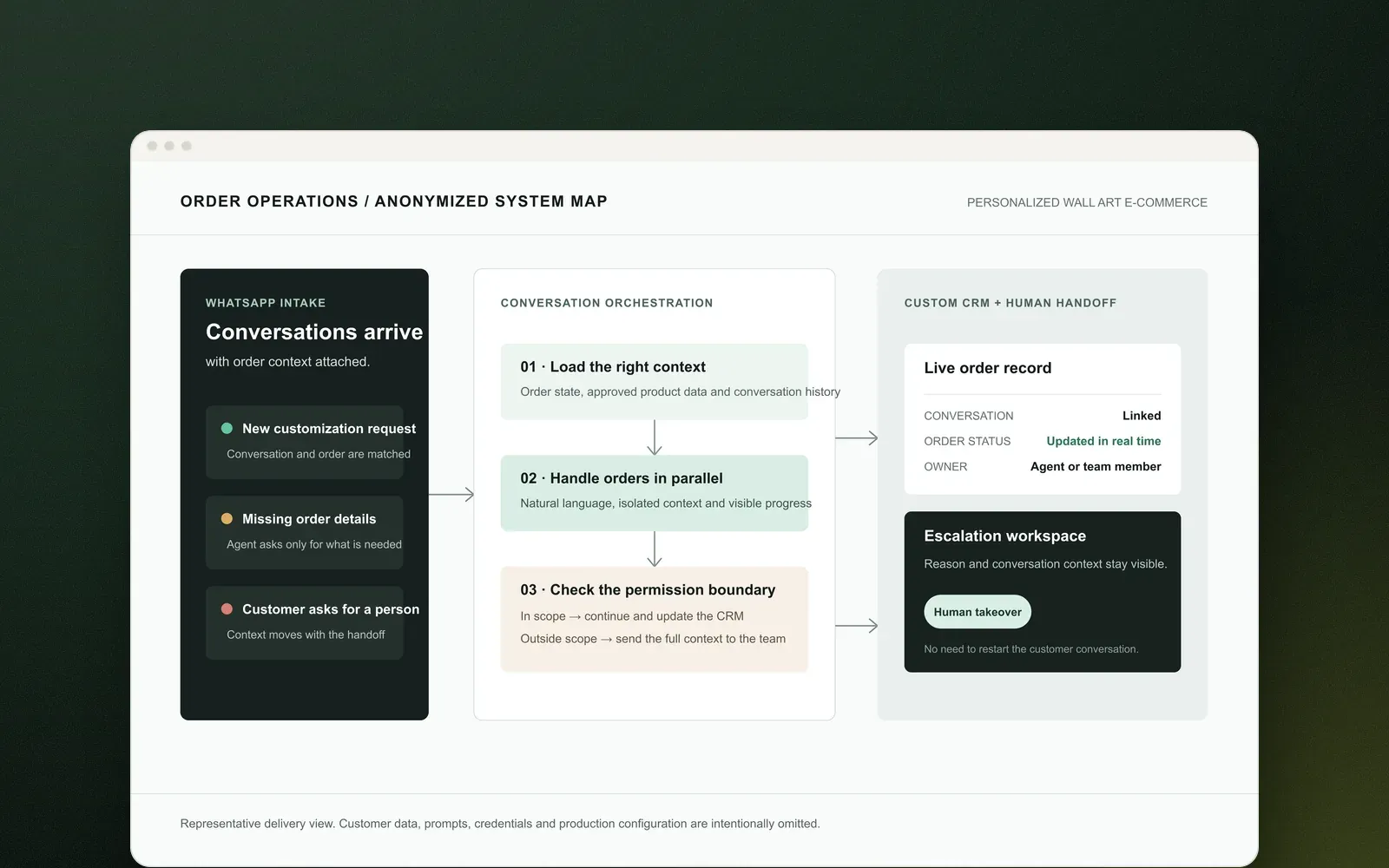
The WhatsApp order agent we built for a wall-art business shows how it works. The agent handles routine order conversations from approved information and writes each order to a custom CRM. Rules check the order details. When a customer asks for a person, raises a complaint or wants something outside the agent's permissions, the chat goes to staff with the whole conversation intact. The case study describes what was built; no outcome metric is published.
If you're planning to sell
Buyers pay for a business that runs without its owner and for records that hold up in due diligence. They don't pay extra for "AI". What helps is the same work as above, aimed at transferability: the loops that still depend on you taken out one at a time, and the customer, job, invoice and staff records kept where someone else can produce them. Our guide Selling in two or three years: the operations checklist buyers test lists those records.
The Audit can be scoped around what a buyer will test. We don't value businesses, broker sales or give tax advice, and we're happy to work with your broker or accountant. Book a sale-readiness call to talk it through.
Partnerships
If your clients keep asking to buy your method, we can build the software product with you, with the model, roles and terms agreed in writing first. Agencies can bring us in to build and run what they sell. Talk about a partnership.
Limits of this overview
This page does not recommend a build or estimate savings for your business. The right choice depends on system access, data quality, exceptions, permissions, volume and who is responsible for consequential decisions. Our case studies document what we built; they do not yet publish outcome metrics.
AI consulting tells you where AI could help. AI implementation builds it and makes it run inside your systems. We do both, in that order: the £3,500 Audit decides which loop to take out first, and the Pilot puts it into production with tests, logging and a handover.
It depends on how many systems and exceptions the process has. Our Pilot is £15,000 excl. VAT for one workflow across up to three systems, with exception handling, an audit trail, handover and a 30-day defect period. Simple one-step automations cost much less, and some need only a setting in a tool you already pay for; if that's your case, we'll say so. Our cost guide lists published UK prices with sources.
One workflow in production, not a demo. Ours typically takes four to six weeks, touches up to three systems, and includes exception paths, error handling, an audit trail, deployment, documentation, handover and a 30-day defect period, for £15,000 excl. VAT. Ask any supplier what happens when an input is missing or a system is down.
Building one agent for one task in production is a Pilot: £15,000 excl. VAT. Running it adds model usage, hosting and channel fees, such as Meta's WhatsApp charges, paid to those providers, plus Run at £2,000 a month if you want us to monitor and fix it. We estimate running costs on your real volumes before you commit.
Our Build is £35,000 excl. VAT for one responsive web app with up to three user roles, one core workflow, up to two integrations, basic reporting and an audit trail, typically over eight to twelve weeks. Price rises with users, integrations, approvals and data migration. Native mobile apps aren't included.
Yes, in the sense buyers usually mean: we build AI automations and AI agents that run business processes. The difference is engineering depth. We also write bespoke software, design failure handling and hand over everything we build, rather than leaving you with no-code flows nobody can maintain.
Ask who builds it, who maintains it, where your data goes, who owns the code and accounts, what the fixed price includes, and how success will be checked. Good answers are specific and in writing. Ask to see a system running in production, and be wary of anyone who won't put a price on the first step.
Access is limited to what each step needs, granted through your own accounts where possible, logged and reviewed at handover. We document where data is processed, how long it's kept and whether any AI provider may train on it, and we support your DPIA. Please don't send credentials or customer data in your first message.
The business does, as set out in the proposal: code, prompts, workflow configurations, documentation and the accounts they run in. We design for portability, so your team or another supplier can take it over. If you sell, a buyer can see the system belongs to the company, not to us or to you personally.
It's worth it where a job runs often and follows rules you can write down. Many firms haven't found one: in the UK government's AI adoption research, a 2025 survey of 3,500 businesses, 71% named the lack of an identified need as a barrier. That's why we start by finding the loop, and sometimes recommend a setting or a standard tool instead.
Next step
Pick the loop that costs you most.
Bring it to a free 30-minute call. We'll tell you what it would take to run without you, and which step fits.